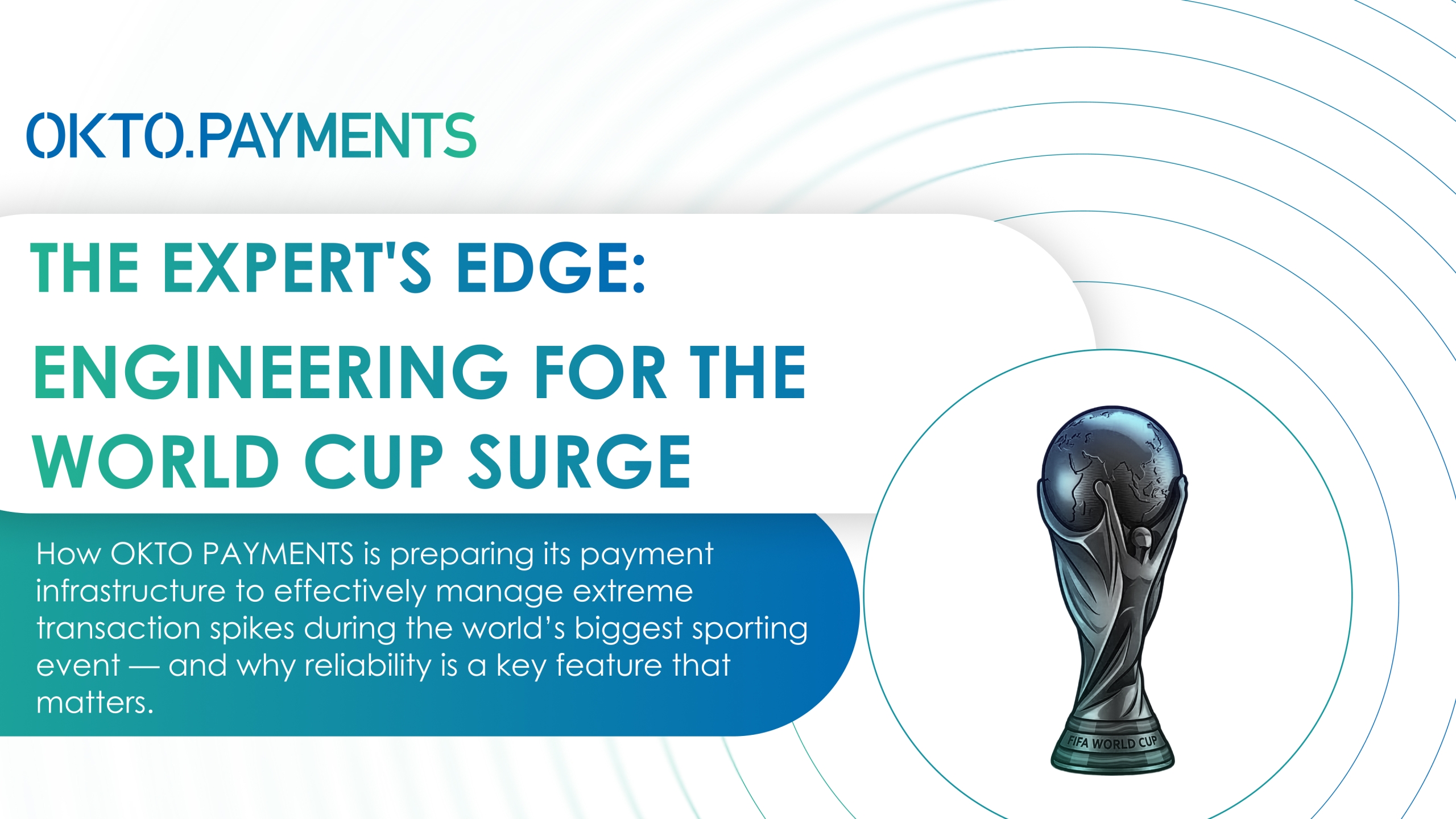
How OKTO PAYMENTS is preparing its payment infrastructure to effectively manage extreme transaction spikes during the world’s biggest sporting event — and why reliability is a key feature that matters.
By Michael Vogiatzis, CTO OKTO PAYMENTS
The World Cup doesn’t wait for anyone to catch up. It doesn’t wait for a hotfix, doesn’t slow down for an engineering review, and it certainly doesn’t forgive pay-ins and payouts failure when hundreds of thousands of users are depositing or settling bets in the same thirty-minute window. Payment infrastructure has to perform exactly as designed.
Major sporting events create some of the most extreme transaction patterns in digital payments. A single goal can trigger thousands of payout requests within seconds. A controversial decision can instantly spike deposits. The shift from normal traffic to peak demand can happen almost instantly.
For a payment platform, this is a reliability challenge first and foremost.
When I look at our dashboards during a major match, I see what most end-users never think about: the invisible infrastructure that makes every deposit instant, every payout reliable, and every transaction secure. What appears effortless to users is the result of months of engineering preparation behind the scenes.
The 2026 World Cup will be the largest operational stress test platforms whether payments or betting platforms have faced in years. What we have done here at OKTO PAYMENTS in order to be ready is relentless preparation. Preparation began more than a year in advance, focusing on infrastructure resilience, observability, and operational discipline.
The Scale of the challenge
Peak sporting events create transaction patterns unlike anything else in our industry. A goal in a semi-final can trigger thousands of simultaneous payout requests. A controversial VAR decision can spike deposits in seconds. The window between “everything is normal” and “everything is on fire” can be measured in moments.
For our merchants, this isn’t abstract. Their players expect instant payouts regardless of what’s happening on the pitch. Their operations teams need confidence that the platform won’t buckle under pressure. Their business depends on trust that takes years to build and seconds to lose.
We took those expectations and worked backward. What would it take to guarantee stability during the most intense demand our merchants will ever see?
Engineering for extreme demand
Sporting events compress massive transaction volumes into short bursts of time. Instead of gradual scaling patterns, systems must absorb sudden surges without degradation.
To prepare for this, our infrastructure is provisioned at five times current peak transaction demand. This is not treated as an emergency capacity buffer but as the operational baseline for tournament periods.
Beyond static capacity, the platform is configured for rapid autoscaling specifically tuned to match-driven spikes, allowing compute resources to expand within seconds when traffic increases.
However, scaling infrastructure is only part of the solution. Reliability also depends on eliminating single points of failure across the entire transaction lifecycle. We’ve validated redundancy across every critical path. We’ve run load, stress, and scalability testing across pay-ins and payout flows, including simulations that compress hours of normal traffic into minutes, reflecting how real match events behave.
. We’ve simulated scenarios that would make any engineer nervous, and then made sure our systems could handle them smoothly.
And our goal is simple. Peak traffic should behave like normal traffic as if it were any other Tuesday afternoon.
At this scale, reliability is about how systems behave together under pressure. That’s why we’ve focused on isolation, graceful degradation, and containment. If something slows down, it should degrade predictably, not propagate failure. Peak traffic should feel boring, because boring systems are the ones that survive extreme conditions.
Obsevability and early detection
Even the best preparation can’t prevent every issue. What matters is how quickly you detect problems and how effectively you contain them.
Our observability stack provides real-time visibility across all transaction and payout flows, with automated alerting designed to surface anomalies before they escalate.
Our World Cup Dashboard tracks everything that matters: transactions per second, acceptance rates, system latency, provider latency, database health, payout processing time, liquidity buffer levels, and fraud indicators. That’s so we detect pressure before it turns into customer impact.
Automated alerts trigger the moment something moves outside expected thresholds.
Small issues should stay small. That’s the principle that guides every monitoring decision we’ve made.
Payouts that don’t flinch
For our merchants, payout reliability is the foundation of their relationship with players. A delayed withdrawal after a winning is a trust-breaking moment that can drive players away permanently.
We’ve engineered multiple layers of resilience into our payment systems. Retry mechanisms, timeout handling, idempotent processing and fallback paths ensure that transient failures are gracefully handled, and do not become permanent problems. System segmentation reduces the blast radius of any single issue.
In markets like Brazil, where Pix has set expectations for instant settlements, our systems are designed to meet those expectations consistently. Not just on quiet afternoons, but during the most-watched sporting event in the world.
What success looks like
At the end of the 2026 World Cup, success won’t be measured by the features we shipped or the headlines we generated. It will be measured by what didn’t happen.
No churn driven by instability. No headline incidents. Predictable behavior under peak load. Merchants who trusted us with their most critical payment flows and found that trust validated, match after match, transaction after transaction.
That’s what we’re building toward.
Playing Differently, hen it matters most
Large sporting events highlight a reality that applies to all payment infrastructure: systems must be designed for peak conditions, not ideal ones.
At OKTO PAYMENTS, the engineering focus remains the same beyond the World Cup, building pay-ins and payout infrastructure capable of performing reliably under extreme demand.
Because when traffic spikes and the pressure increases, the systems that were designed for those moments are the ones that continue to perform.